King Arthur Baking Dutch Oven Dinner Rolls. Recipe is here
2025 Thanksgiving modifications:
All of the water (227g) , milk powder (28g), 70g whole wheat flour (Sonora White), 157g AP flour, and a tiny tiny pinch of active dry yeast were combined into a poolish, covered, and refrigerated for 2 days. I also removed the butter from the refrigerator at that time to ensure it was room temperature when needed.
About 4-5 hours before time to bake, combine the rest of the ingredients (including the remaining 127g AP flour) and mix until a smooth ball of formed.
The recipe calls for a total of 350g flour, one half AP and one half whole wheat. I used 20% of the total flour weight as fresh milled Sonora White flour.
The rest of the recipe was used as directed except that I baked 10 minutes covered and 13 minutes uncovered. I have found that 15 covered and 10 uncovered leaves the tops relatively light.
The poolish and Sonora White combined nicely to make smooth but interesting on their own dinner rolls.
Returning to chess many years later, I’m realizing that “modern theory” didn’t wait around while I was gone. Almost all of the books that I read back in the day were written pre-1960.
The 12th century Lewis Chessmen
I recently came across Secrets of Modern Chess Strategy: Advances Since Nimzowitsch by John Watson. (Nimzowitsch’s classic “My System” was written in 1925.) I’d heard of Watson’s book, and it happened to be available at the local used book store, so that one has been added to the library. Modern Chess Strategy was written in 1998, which for me qualifies as “new theory”.
In a lot of respects Modern Chess Strategy has been more eye-opening for me than Silman’s How to Reassess Your Chess. (Published 2010). Given the reading foundation I already have, the Silman book seemed like a lot of “I’ve already seen that idea”. Though there are a lot of people who read Silman’s book and attribute significant rating gains to having read it.
All of this is not intended as a dig at How To Reassess Your Chess. Had I not already worked through Pawn Power In Chess (Kmoch), My System, and other old classics, I’m sure Silman’s book would have opened up my mind to a lot of things that I’d previously had no idea about.
So that’s not where intended this blog entry to go…
My phone has been acquiring an increasing number of Chess apps and website links, with an emphasis on free stuff. I might be fine with paying a one-time fee for some of these sites, or making a donation, but I’m not going to sign up for several hundred dollars annually in courses and membership fees. There are some instances better database manipulation would be nice, but I have no intention of ever turning pro, so I can live with my workarounds. Chess can be an almost free hobby if you want it to be.
Listed below is online stuff I’ve been using. Note that I’m not covering all of the features available for each, just the features I’m using right now. Most of these offer games and training at the very least:
The Lichess app, Lichess.org, and Listudy: The Lichess app is where I spend most of my chess time. All free, no ads, free studies about nearly any chess subject. You can even personalize studies if you choose to. Or create your own study with the subject you’re focused on. Terrific resources. Lichess.org is the web version which offers some different functionality. Listudy is maintained by a different group of people I think, and offers some training and studies.
Chess.com: Monetized through and through. Some good free stuff available but if you’re not willing to pay a monthly fee then many or most of the useful things are behind a paywall. For me that’s a hard pass.
Chessbook: I’ve been using this for spaced repetition opening training. The free limit is 100 moves per side per color. That worked fine when I could fit all of my white openings with only a few lines each under the limit. I’m now to the point where I can practice a subset of the current white opening that I’m working on, so I’ve broken the opening into smaller modules that I can save and swap out when I want to work on something else. Again, workarounds.
PGN files: Mostly freely available from virtually every site. Games, openings, studies, you name it. This is (I think) the most common file format for chess content. Many websites and apps will allow you to export your study/opening/game to a PGN file, which you can save and share with other sites or friends. I’m still learning the syntax for writing directly into a PGN file — it hasn’t been a priority yet so it hasn’t happened.
Scid vs PC: A PGN Database handler, among other things. I’ll be using this a lot more in the future. You can import games/ openings/ studies, etc in PGN form. It allows for chess engine plug-ins. It’s free in contrast to many other options. I haven’t had the time to really explore this yet either, but I think it’s going to get a lot of use.
Chessable: I’ve started using Chessable a little more lately. They offer free courses, with a whole bunch more courses behind a paywall. There are a couple of free openings courses that I’m working through, but I don’t know what my long-term relationship with that site is going to look like. I do think there’s some functionality I haven’t really looked at yet, so maybe I’ll be singing a very different tune later.
QChess.net: Pretty new, and I only happened across it last week. There’s a searchable database and an opening trainer, among other features.
Chess Tempo: Has both an app and a web presence. I’ve been using its Advanced DB search to look for particular players playing particular openings. It offers many other features as well that I haven’t delved into yet.
And that’s what I’ve found in the first couple of months. I know that I’m missing a bunch of quality sites and quality content creators. This blog post will likely need a revisit at some point.
As for me, I’m not playing a ton of games, and I started out with a relatively not-awesome Lichess Rapid rating, but my win rate remains high and I’m gaining a significant amount of rating each month. I’m sure there’s a plateau coming eventually but I haven’t hit it yet. “To Infinity And Beyond!” …. No, of course not. But the journey is fun.
Before home internet. That’s the last time I would have been considered an “active” chess player. At that time the resources for learning were either books or people. Back then I was a member of the local chess club, and I had a small handful of books including Bobby Fischer Teaches Chess, Pawn Power In Chess by Hans Kmoch, Nimzovich’s My System, and a massive encyclopedia of openings that probably dated from the 1970s.
I recently got the bug again. I did some internet reading, and started watching a few Youtube videos. I loaded the Lichess app onto my phone (totally free and no ads!), and after a couple of games against bots decided to try some rated 10+5 games (10 minutes + 5 seconds added per move).
To backtrack just a bit — when I played at the club a zillion years ago many of the players were better than I was. Everyone had favorite openings and pretty much stuck to them. My openings were mostly sharp, tactical, and study intensive because I liked games like that. (Ruy Lopez or Sicilian Dragon as white, Sicilian Dragon as black when I could get them. I was trying to attack and channel Fischer and Alekhine.) Overall though, the whole experience was pretty controlled and genteel.
When I recently started playing online I discovered I was playing against a large percentage of people who would substitute traps, straight aggression, or just insane crazy moves in place of what I’d call an “opening”. Initially I had trouble with it and it’s taken a little while to adjust, but by now I’ve figured out that if I just play it cool and “sound” — most of that stuff blows up at some point and I’ll have a superior position. But it’s wild, at the level where I am there’s a lot of rock fights.
So now I’d be considered an Adult Learner. Or Adult Improver if was ambitious and trying for a high rating. What that means to the community is that I have interest in the game but I also have a very definite ceiling as to how far I could reasonably advance, mostly due to lack of a malleable brain and a finite time available for commitment. Which is fine with me, I’m having fun with it. I enjoy the learning and I enjoy the competitiveness of playing the games. I do want to improve but I don’t have any illusions of ever getting to be better than the level of a respectable club player.
I’ll close with a few things that have been helpful for me getting back into the swing of it after a very long time away.
For Youtube: I watched all of the Chessbrahs Building Habits series. Building Habits is pretty universally recommended and it helped me feel much more comfortable and confident. I watched a number of Gothamchess videos (Levy Roseman). Lately it’s been Daniel Naroditsky, who to my mind does the best job of teaching more advanced concepts and getting deeper into the positions and potential positions in his games.
For general books: How To Reassess Your Chess: Chess Mastery Through Chess Imbalances by Jeremy Silman (4th ed). By far the most recommended book I’ve seen and for good reason. It covers some of everything. I can do without some of the writing style, but it was a very good refresher for a lot of concepts for me with a few new ideas sprinkled in. Lots of people say they get better after reading this book. His endgame book is very highly regarded as well. I own it, but I haven’t gotten deeply into it yet.
I also feel more comfortable when I have openings to refer to as a templates for piece and pawn placement. For me, even learning 5-7 moves into a smallish numbers of common openings helps me not wind up all twisted going into the midgame. My pieces tend to wind up better deployed if I have the framework of an idea to work around.
I always played e4 (Kings Pawn) back in the day (The Fischer influence, again). Returning to chess, I was looking for a repertoire that wouldn’t require a ton of study and matched what I think I want the games to broadly look like. I landed on A Simple Chess Opening Repertoire For White by Sam Collins. It includes some openings I had already independently decided I was going to use, such as the Alapin Sicilian against …c5 and the Italian Game against …e5 . There were a few of other commonalities as well. The overall theme of the book is sound openings requiring limited study where I can still start with my preferred e4. The repertoire is based around white steering the game into Isolated Queens Pawn (IQP) structures, where the white advantage is to come from superior familiarity with the ideas of the position. The IQP approach is newish to me, but I happened to spend part of a week in a cabin in the woods with the book and no internet, and I’ve now worked through most of the main lines presented. I think the framework has promise.
———
Thoughts about the blog:
I used to write about games fairly frequently here. Given that chess currently has my interest I’d imagine I’ll be posting about the subject as well going forward. I can also see my sourdough baking getting more attention. We’ll see what else gets my attention next — I was feeling in a rut, and today’s chess post is fresh air.
We cut back on the 2026 garden for a variety of reasons. One of the reasons is the yield is declining every year.
Mid-morning picture taken before the sun has come over the house, facing west.
That yellow tree was planted shortly after we moved in. The garden is in the back of the house facing west, and the sun sets through that gap between the trees, mostly on to the left, which is south. Very conservatively I think it’s reduced the amount of direct sunlight on the garden by at least 30%.
For our 2025 garden we’re growing basil, Oregon Spring tomatoes, and cucumbers. We just harvested the first ripe tomatoes. The basil has been doing fine. We’ve also gotten a decent numbers of cucumbers from two plants, though the cucumbers are now mostly done for the year. To be fair, we started a little late this year, so that could be contributing to the somewhat late harvest.
Going forward, I think we’ll continue with a more limited garden, at least so long as we eat the output. If I get excited or have extra time available maybe we’ll try growing something in the front of the house on a limited scale — there’s not much space without tearing up the yard. Alternately we’ll go all-in, pull out a few shrubs, and tuck a long skinny greenhouse up against the front of the house.
On the other hand — we have a big yard for suburbia, so as I age I may also decide the yard is plenty of work as is. One of our older neighbors moved out a few years ago and he said at the time that the yard and house was too much for him to maintain. We’ll see how it goes.
My current favorite sandwich bread using Bread Flour, Rogue de Bordeaux flour, and sourdough discard. The recipe is easy:
600 grams flour total:
350 grams King Arthur bread flour (58% of the flour weight)
200 grams Rogue de Bordeaux flour (33%)
100 grams sourdough discard (50 grams flour (8% of the flour weight)/ 50 grams water)
370 grams room temperature water (with the water from the sourdough the total hydration is 70%)
12 grams extra-virgin olive oil (2% of flour weight)
12 grams kosher salt (2% of flour weight)
1 tsp instant (not rapid rise) yeast
Combine all ingredients in a mixer and mix on low speed for 8 minutes. Lightly spray a Pullman Pan and move the dough to the Pullman Pan, patting it down and spreading to the ends. Cover and let rise until the dough is 1″ from the top of the pan. Preheat oven to 350F.
Bake covered 30 minutes, then remove the cover and bake an additional 25 minutes. De-pan to a cooling rack.
1/3 of the flour by weight is the Rogue de Bordeaux. This seems to be a good ratio of whole wheat to regular bread flour. The bread has good structure. The Rogue de Bordeaux adds a lot of the flavor and cinnamon and baking spices. One neat thing is that it highlights different flavors in the sandwich depending upon the ingredients.
The Pullman Pan works well for the relatively extensible Rogue de Bordeaux. Using wet hands for all handling helps a lot.
A friend of mine expressed interest in a recipe for a gluten-free flatbread, since they weren’t happy with any of the pre-made mixes they’d tried. That sparked my interest too — and I spent a bunch of hours digging around forums and websites looking for commonalities and differences among the recipes I could find.
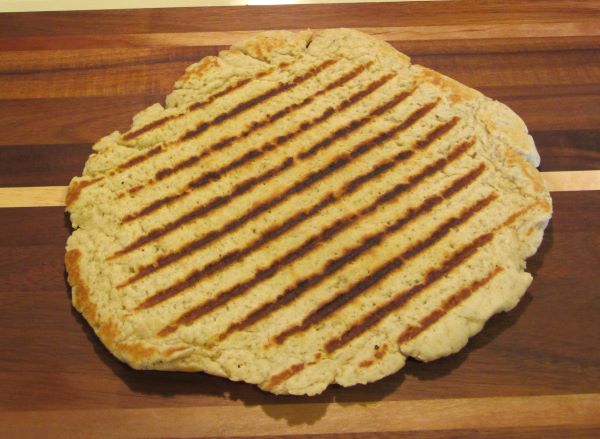
This recipe makes a flatbread that just fits into our grill pan. When the flatbread comes out of the grill pan it’s flexible — to make it crispy on the bottom put the finished bread onto a pizza stone at 450F for 2-3 minutes. The oven is also a good way to warm up any desired toppings.
I’ll post some other thoughts towards the bottom of the post.
The Recipe:
Wet Ingredients:
110g lukewarm warm (~100F)
40g milk powder
8g psyllium husk
10g extra virgin olive oil
Dry Ingredients:
65g Super Fine Brown Rice Flour
20g Tapioca Starch/Flour (same thing)
10g Corn Starch
5g Potato Starch
4g Baking Powder
3g Kosher Salt or Sea Salt
The steps:
Add the lukewarm water to a mixing bowl. Add the powdered milk and whisk to combine.
Add the psyllium husk and whisk to combine. Let rest a few minutes to let the psyllium husk hydrate.
In a separate bowl combine all of the dry ingredients and stir to distribute.
Add the olive oil to the wet, now viscous milk mixture. Whisk to combine.
Add the dry ingredients to the wet ingredients. Starting with a spoon or spatula mix to combine.
“Knead” and press the mixture until it becomes the texture of masa. I use my knuckles to fold and press the dough into the leftover dry bits until it’s completely combined.
Preheat a pan to medium-high. I use the same temperature that I use for hashbrowns. I want brown but not charred.
Cut a piece of parchment to the same size as the pan. Mine is 8″ x 8″.
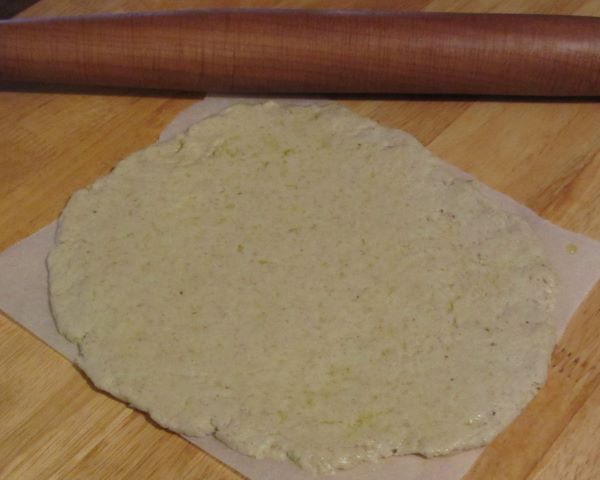
Oil the parchment and roll out the dough to 1/4″ thick. (picture below)
Oil the top of the dough.
When the pan is up to temperature, invert the dough/parchment onto the pan and peel away the parchment paper. Add more oil to the top if it looks dry.
Bake 3 minutes on side one, then flip and bake on side two another 2-3 minutes. I use two spatulas to flip to try to make sure the bread doesn’t break.
At this point the dough can be topped and reheated in the oven.
For pretty edges, trim the outside with a knife or pizza cutter. I’m always ok with rustic.
When creating the recipe I wanted to pin-down at least one variable. I decided that 100g of flour + starches would fit pretty well in the pan so that became the “base”. The end result is (65g brown rice + 35g total starches = 100g). More notes on that ratio below. Once I settled on the dry weight only the wet weight required adjusting.
The tapioca / corn starch / potato starch ratio was partly inspired by a forum post on pizzamaking.com, and partly because I was targeting a particular mouthfeel and taste in combination. Every starch has a “signature” taste and mouthfeel, I tried to avoid using too much of anything so that when people eat it they won’t say “that’s tapioca”, or “that’s corn starch”. I started with way too much potato starch, which has a pleasant taste, but too much and it becomes dense and “potatoey”.
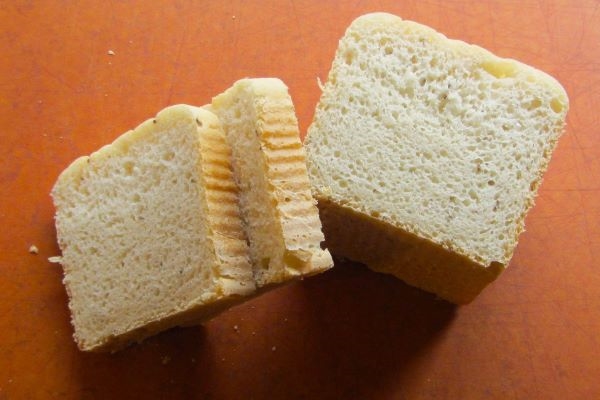
Flexible when it comes out of the pan.
Some other commonalities among gluten-free baking recipes, broadly:
2% salt by weight is a very normal amount in all bread baking. This becomes 3g in the recipe above due to all the other stuff in addition to the 100g of flour and starch.
4% baking powder by weight is normal. This one took a little more digging since almost without exception people use volumetric measures.
For gluten-free flatbreads the ratio of flour to starch varies quite a bit but often lands around 2 flour to 1 starch by weight. Water tends to be around the same weight as the combined weight of the flour and starch. “Regular gluten-free breads” tend to be more around 1:1 flour:starch by weight.
One other thing I learned that I didn’t know going in, was that the potential ingredients/exchanges can vary a lot in weight, given the same volume. I always bake with metric weights, so changing one component for another was pretty simple, and I usually didn’t have to mess with the amount of liquid required to get a similar dough ball.
More so than in “regular” (gluten) bread baking, substituting anything will make for a different, or very very different end result. The ingredients themselves have different tastes, or they hydrate differently, or they give a different mouthfeel. I know that this recipe gives consistently pleasing results. Changing anything will basically make it a different recipe. It may still have a good taste and texture, it’ll just be different, and using a substitution may require more fiddling to make it work.
Finally: The most obvious way that this recipe differs from pre-made mixes is it uses psyllium husk rather than xanthan gum, or guar gum. I think the reason so many mixes contain xanthan gum, and by extension so many people include it in their recipes is this: It doesn’t require a separate hydration step and it can be bagged and shipped together with the rest of the pre-made mix. I feel like Xanthan gum has its places but psyllium husk was the better choice for this recipe.
We recently had the opportunity to attend the Salt Blade speaker series at Eight Bells winery. Events like these are always informative – people devote their lives to making good wine and good charcuterie, so they know a million times more about the subject than we do, and they’re happy to describe they whys and hows of what they’re doing in detail.
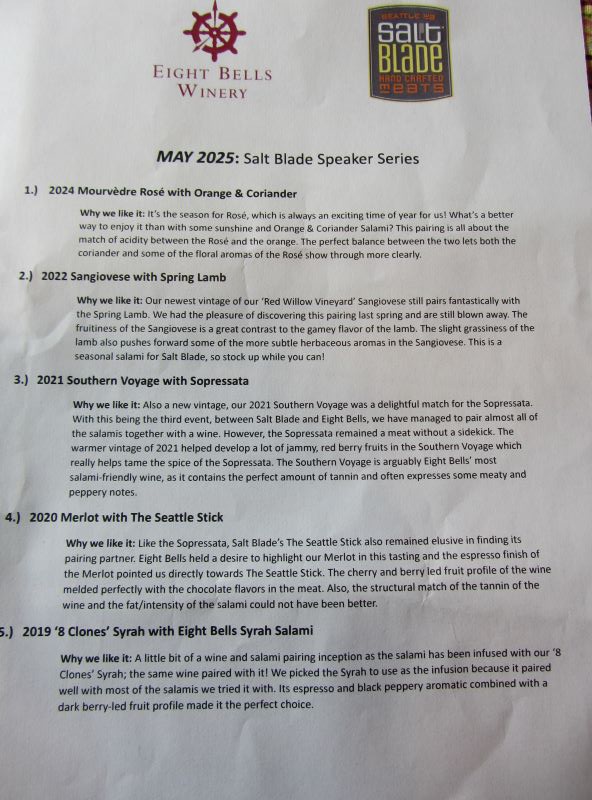
This event included wine with charcuterie pairings. The menu:
Our somewhat wrinkled menu. No wine or sausage stains though. We had two menus and this one gets the picture.
We were served the Rosé as a warmup. After some introduction from the principles, it led into the first pairing with Salt Blade’s Orange and Coriander stick. The Orange and Coriander is among Salt Blade’s best sellers, and for good reason, it has a universal appeal. The Rosé served as a great opener and it was a good marriage with the charcuterie.
Eight Bells and Salt Blade have done pairing sessions before. Some of the pairings were repeats from past events. One of the new pairings was Sangiovese with the Spring Lamb, which we thought was perfect. The Merlot with the Seattle Stick was pretty flawless as well. I like spicy, so I especially enjoyed the Southern Voyage with Sopressata.
There was further presentation throughout the pairings intermixed with Q+A about both the wine and the charcuterie. The doors were open and it was a beautiful spring night. We purchased more than a few things so that we can share some of our favorites with our friends. Thanks to everyone for a nice evening-
A few months ago I decided to begin maintaining a starter. To that point I’d avoided it, partly because I didn’t want Another Living Thing to maintain, partly because the idea of throwing away starter seemed wasteful, and partly because it just felt like it was going to be a messy and unnecessary hassle.
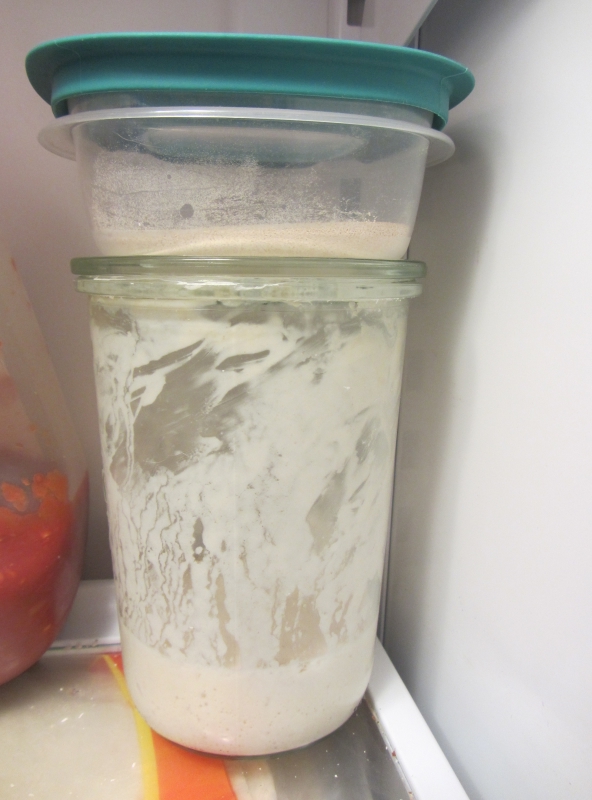
Hanging with the salsa.
The flip side of maintaining a starter would be that it would allow for more interesting things to try with breadmaking. It would also add another “color” to my available “palette”. The end product could be better tasting, better for us, and keep longer before spoilage. Ultimately I read enough intriguing starter-based recipes that I decided to give maintaining a starter a try so I took the leap.
I wanted a starter recipe that wouldn’t consume or waste much flour. I also wanted a starter recipe I could mostly ignore after it was finished. I settled on Ken Forkish’s Levain recipe from Evolutions In Bread. The entire process requires one week and 550 grams of flour.
Creating the starter is pretty simple really. Weigh the container and write that number down. Every 24 hours some amount (by weight) of the contents of the jar will be discarded and then the container will be fed a small amount of fresh water and flour. I made the decision ahead of time to mill all of the whole wheat flour I was going to need, 250 grams total. That way I wasn’t getting the mill out for the first few days when it was time to discard and feed. The process felt very easy and pretty bulletproof — I think that fresh milled whole wheat contains enough nutrients and enough bacteria/enzymes/assorted microbes and whatnot that kicking off the new tiny ecosystem basically took care of itself.
The recipe it calls for 250 grams of starter as the end product. I “shorted” the final feeding and I didn’t see any adverse effect. I did that because I wanted to be able to pull a smaller amount out of the jar each week and still keep things fresh and lively with smaller feedings. If I want to build up a large quantity of starter it takes a little longer but I’m fine with that.
I maintain 150 grams of starter in a 393 gram jar (weighed with no lid). Each week I take a small spatula and scrape/pour out 100 grams for bread baking. I then add 50 grams of bottled water and 50 grams of bread flour to the container, scrape down the sides, and stir it up. I put the lid back on and let it sit on the counter for 1-2 hours, until it starts to show some signs of life. Then it goes into the back corner of the refrigerator for another week. I store yeast in a tupperware-type container on top of the starter. Everything is in one place and ideally staying fairly cold.
As for the container – it became clear pretty quickly that straight sides are a good thing and a threaded jar is a bad thing. Straight sides because it’s much easier to get into and scrape down the jar when there’s no “neck”. Threads just gather crud and rapidly clog. I purchased a 6-pack of the Weck 743 jars and split it with a friend who was also making a new starter. (At the time the total cost was ~$6.50 per jar for six.) I use them without the gasket. They’re nice somewhat heavy jars made of thick glass. The lid just sits on top and it’s plenty secure.
Final thought: Evolutions in Bread is a great book. Highly recommended.
This week’s sandwich loaf steers back towards “normal”. It includes a bit of sourdough starter, caraway, and milk powder. The caraway is the most obvious flavor.
450 grams bread flour (500 grams bread flour total including the starter.)
300 grams room temperature water. (70% hydration, the water amount is 350 grams total including the starter)
50 grams milk powder (10% bakers percentage)
15 grams olive oil (3%)
10 grams kosher salt (2%)
1-2 teaspoons crushed/ground caraway seed. I didn’t go too fine because I still wanted to see flecks of caraway.
1.5 tsp instant (not rapid rise) yeast.
Combine all ingredients. Mix until combined, about 1 minute at low speed. Cover and let rest 30 minutes. Mix for 8 minutes on low speed.
Oil / butter / Baker’s Joy the pullman pan. Move the dough to the pullman pan and spread the dough out to the sides of the pan. Cover and let rise until 1″ from the top of the pan. Bake at 350F covered for 30 minutes, then uncover and bake an additional 25 minutes.
The finished loaf had a lighter crust color this time, partly because I left out the usual honey. The crumb was spongy and moist with dark flecks of caraway — it worked really well as a sandwich loaf and I think it’ll make good toast if it lasts that long.
Overall the finished bread was simple, quick, and fairly interesting on a baking night where I wanted simple, quick, and easy. Perfect.
Combine all ingredients, cover, and let rest 30 minutes. At the 30-minute mark do Rubaud folds in the bowl. Repeat at 30-minute intervals for a total of four rounds of folds.
Shape the dough and move to a Silpat-lined sheet tray. Dust with flour and cover for 90 minutes. At the 60-minute mark preheat the over to 425F. Slash the dough. Bake for 50-60 minutes, or until the bread reaches 200F.
I guess technically some people would call this a 1.7kg (or 3.7 lb) loaf since that’s the total weight of the ingredients. I always think of it in terms of “how much flour is there”, so for me it’s a 1kg loaf.







 FlatbreadGarden